
On-prem or cloud AI for a factory: what to choose and when
> Reading time: approx. 7 minutes · Who it is for: owners and managers of mid-sized manufacturers, IT and maintenance managers, people preparing an AI business case.
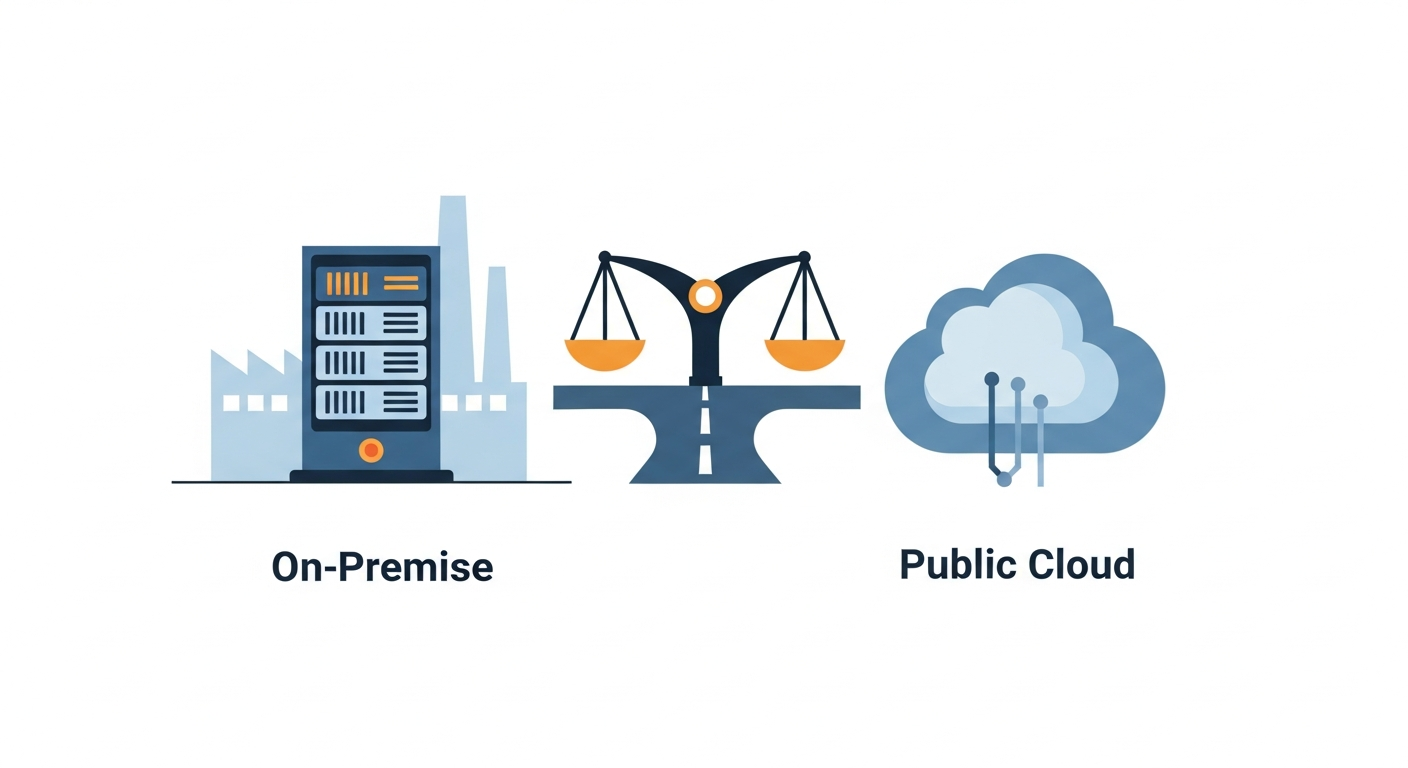
There is no single right answer, but a few factors tip the scales. On-premise, meaning AI on your own hardware, wins when data is sensitive or covered by agreements, when the volume is large and constant, or when you need full control and offline operation. The public cloud wins at the start, with uneven or low volume, and when you do not have a team to run a server. The key is an honest calculation: the cloud bills for usage and grows linearly with volume, while on-premise is a one-off hardware spend plus power and people over several years. Below we break this into five questions, add a decision table, and show the hybrid option that is most often forgotten. The hardware decision itself we leave to a separate note on local LLM requirements.
| Factor | Lean on-premise | Lean cloud |
|---|---|---|
| Data sensitivity | high, NDA, IP, NIS2 | low, data already in cloud |
| Volume | large and constant | low or irregular |
| Horizon | 2 to 3 years or longer | pilot, short term |
| IT team | resources to maintain | no operational resources |
| Latency and offline | critical | not a factor |
| Cost | one-off hardware plus upkeep | pay per use, grows with volume |
On-premise AI (on your own hardware)
- Data never leaves your infrastructure, removing a whole class of questions about processing location and subcontractors.
- With large, constant volume the cost is predictable: hardware bought once handles the same traffic without a rising fee.
- Full control and offline operation, a shop-floor assistant works even when the connection drops.
- Simplifies some NIS2 questions, because data stays inside the perimeter.
- High entry cost and capital tied up in hardware.
- Total cost of ownership is more than the card: power, cooling and the people to maintain it.
- You buy hardware for peak but use it at 40 to 65 percent on average, paying for the whole thing.
- Requires a team to set up and maintain the server.
Public cloud AI
- Fast start with no hardware investment, you pay for actual usage.
- Flexibility with uneven or spiky load, you scale up and down.
- No in-house hardware operation, updates and maintenance sit with the provider.
- A good choice for a pilot and a short horizon.
- Data leaves the company, which can be a problem with NDAs, intellectual property and security policies.
- With large, constant volume the usage bill grows linearly.
- Dependence on the connection, latency can be critical in narrow shop-floor cases.
- Under NIS2 there is the added topic of processing location and provider risk management.
Question one: can the data leave the company
This is often the factor that ends the discussion. If you work with NDA-protected documentation, client intellectual property, or data that security policy forbids sending outside, the public cloud becomes a problem regardless of cost. On-premise is then the simplest answer: the data never leaves your infrastructure, so a whole class of questions about where and by whom it is processed disappears. If, on the other hand, you work with low-sensitivity data or data already kept in the cloud, this factor is not decisive and the decision comes down to cost and convenience.
Question two: what is the volume and how constant
The cloud usually bills for usage. That is great at the start and with irregular traffic, because you pay for what you actually consume and do not tie up capital in hardware. The problem appears when volume grows and stabilises. Then the usage bill grows linearly, while your own hardware, bought once, handles the same traffic without a rising fee. Rule of thumb: the more predictable and high the load over a two-to-three-year horizon, the more on-premise starts to pay off. The more experimental, one-off or spiky, the more the cloud.
Question three: have you calculated the full cost of on-premise
This is where most mistakes are made, usually in favour of on-premise, because only the price of the card is counted. Total cost of ownership is much more: hardware as a one-off, power and cooling (data-center cards draw a lot of energy, and cooling adds tens of percent more), the people to maintain and update it (over three years this labour can exceed the cost of the hardware itself), and actual utilisation. You buy for peak but use it at 40 to 65 percent on average, so you pay for the whole thing. A fair comparison puts the full on-premise cost next to a three-year cloud bill. Only then can you see which option is cheaper for your specific case rather than in general. How much hardware a given model actually needs we broke down in the note on local LLM hardware requirements.
Question four: latency and offline operation
There are applications where response time or independence from the connection matters. An assistant on the floor that must work even when the internet is down, or a process where network delay is a problem, argues for a local solution. For most office and service applications cloud latency is practically irrelevant, so this factor tends to apply to narrow, specific cases.
Question five: NIS2 and the supply chain
If your company is subject to NIS2, the choice of an AI provider and the location of data processing become part of supply chain risk management. On-premise does not ensure compliance automatically, but it simplifies some questions: the data does not leave the perimeter, so the topic of processing location and subcontractors disappears. This is a real consideration for essential entities, although compliance itself must still be implemented separately. How NIS2 looks at a public cloud LLM provider from the supply chain angle is broken down in detail by aionprem in its analysis of public cloud LLM and NIS2, Article 21(1)(d).
The forgotten option: hybrid
The choice is not binary. In practice a common and sensible setup is a hybrid one: the most sensitive data and processes stay on-premise, while less sensitive or spiky workloads go to the cloud. This way you do not overpay for hardware to cover peaks, and at the same time keep in house what must stay. It is a good starting point when the factors conflict.
How to approach the decision in practice
Start with the data question, because it most often settles things on its own. If the data must stay in house, the rest of the discussion is only about how well to build on-premise, not whether. If the data can leave, move to volume and full cost, and calculate both options on the same, realistic load figures. Only at the end look at latency, because for most applications it does not tip the balance. The same order-of-decision logic returns in our notes on assessing AI readiness and on calculating ROI: the hard factor first, then cost, convenience last.
What this comparison does not cover
We do not go into the details of hardware selection, as that is a separate topic we break down in local LLM hardware requirements. We also do not decide whether to place the hardware on your own site, in colocation, or as a ready-made appliance. We do not give amounts or percentage savings, because they depend on your starting point. The focus here was the earlier decision: on-premise or cloud, and which factors truly tip the scales.
Related
- Local LLM on a company server: what hardware you need (GPU, VRAM)
- ROI from AI in manufacturing: how to calculate it and what to leave out
- How to choose an AI vendor for manufacturing: 10 questions before the RFP
- How to assess your manufacturing company's readiness for AI: 5 questions
- RAG for technical documentation: how AI uses the technical manual and machine instructions
- Public cloud LLM and NIS2: Article 21(1)(d) analysis (aionprem)
Verdict
If the data has to stay in house or the volume is high and constant over a two-to-three-year horizon, on-premise wins. Otherwise, especially at the start and with uneven traffic, the cloud is cheaper and faster, and when the factors conflict the best starting point is a hybrid.