Choosing an AI Vendor for Manufacturing: 10 Questions Before the RFP
Before you send the RFP, ask these ten questions. They separate an AI vendor that's ready for production from a polished slide deck.
In this note
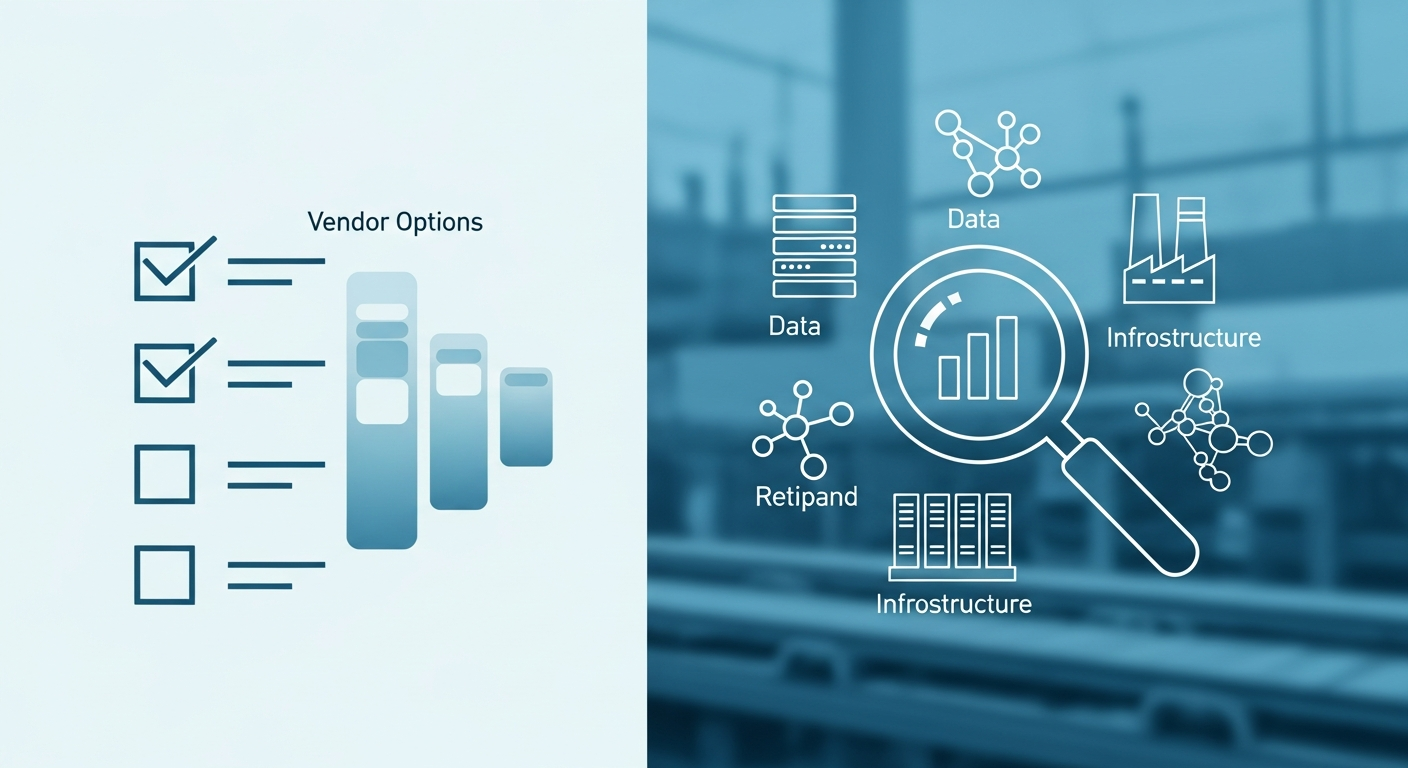
Choosing an AI vendor is not the same as picking another SaaS tool. A bad decision means sensitive documents in someone else's cloud, a cost that creeps up quietly, and a deployment that's hard to leave. Before you send the RFP, it pays to ask a few questions that separate a production-ready vendor from a polished slide deck. Here are ten, grouped into five areas.
Data and isolation
1. Where is our data physically processed? This is question number one for a manufacturer. If the answer is „in the public cloud, somewhere," and you work with recipes, process parameters, or customer documentation, you already have a problem to solve before you deploy anything.
2. Is our data isolated from other customers? Shared infrastructure means your documents sit next to someone else's. Ask plainly whether the deployment is single-tenant or shared, and what that means in practice for isolation.
Deployment
3. Can this run on our infrastructure? For some firms, on-prem or a private dedicated cloud is not a preference but a hard requirement. If a vendor only offers public cloud, they simply aren't the vendor for you, however good the rest is.
4. How long until the first real use case is live? Not a demo, but something that actually takes load off the team. If the answer is „a few months of integration before you see anything," the risk of the project stalling goes up.
5. What exactly do we need to prepare on our side? A good vendor tells you plainly which documents, access, and people's time they need. A vague answer here usually means surprises later.
Total cost
6. What does the pricing model really look like? Ask not about the first-slide price, but about what grows with use: number of users, document volume, queries, infrastructure. A cost that scales non-linearly can surprise you after a year.
7. What's included and what's an add-on? Support, updates, tuning to your documents, additional use cases. The line between „included" and „separate" decides the real budget.
Exit
8. What happens to our data when we end the relationship? Do we get it back, in what form, and is it deleted on the vendor's side. No clear answer is a warning sign.
9. How dependent do we become on one vendor? The harder it is to leave, the weaker your position in every later conversation about price and terms. Assess this before you sign, not after.
Support
10. Who responds when something breaks, and how fast? In manufacturing, a tool that's down costs money. Ask about the real contact channel and response time, not an inbox where tickets land and vanish.
How to use this
Don't treat this as a checklist to tick off, but as a framework for the conversation. A vendor that answers plainly and specifically, even when the answer is „we don't do that," is worth more than one with a smooth line for every question. In manufacturing, predictability is what counts, and these ten questions test exactly that.
If you're not yet sure whether your firm is ready for this conversation, start with five questions about AI readiness. And if you're thinking about a pilot, it helps to know what can realistically be done in eight weeks. For the wider picture of AI workflows in manufacturing, see the overview of five use cases.
Related notes
How to measure whether an AI rollout succeeded: a KPI framework
The success of an AI rollout is not one number. A KPI framework on three levels (adoption, process, business), with a baseline before you start and an adjustment criterion. How to measure whether it really worked.
From AI Pilot to Rollout: How to Avoid Pilot Purgatory
Pilot purgatory is an AI pilot that neither wins nor fails, it just lingers in extensions. Why pilots get stuck and how to tell when yours is ready for a go/no-go call.
AI in Production Planning: Where It Helps, Where It Fails
AI in production planning: where it genuinely helps and where it only creates an illusion of control. Which scheduling and APS uses hold up, and which are vendor promises.