
How to measure whether an AI rollout succeeded: a KPI framework
The success of an AI rollout is not one number. A KPI framework on three levels (adoption, process, business), with a baseline before you start and an adjustment criterion. How to measure whether it really worked.
In this note
How to measure whether an AI rollout succeeded: a KPI framework
Reading time: approx. 7 minutes
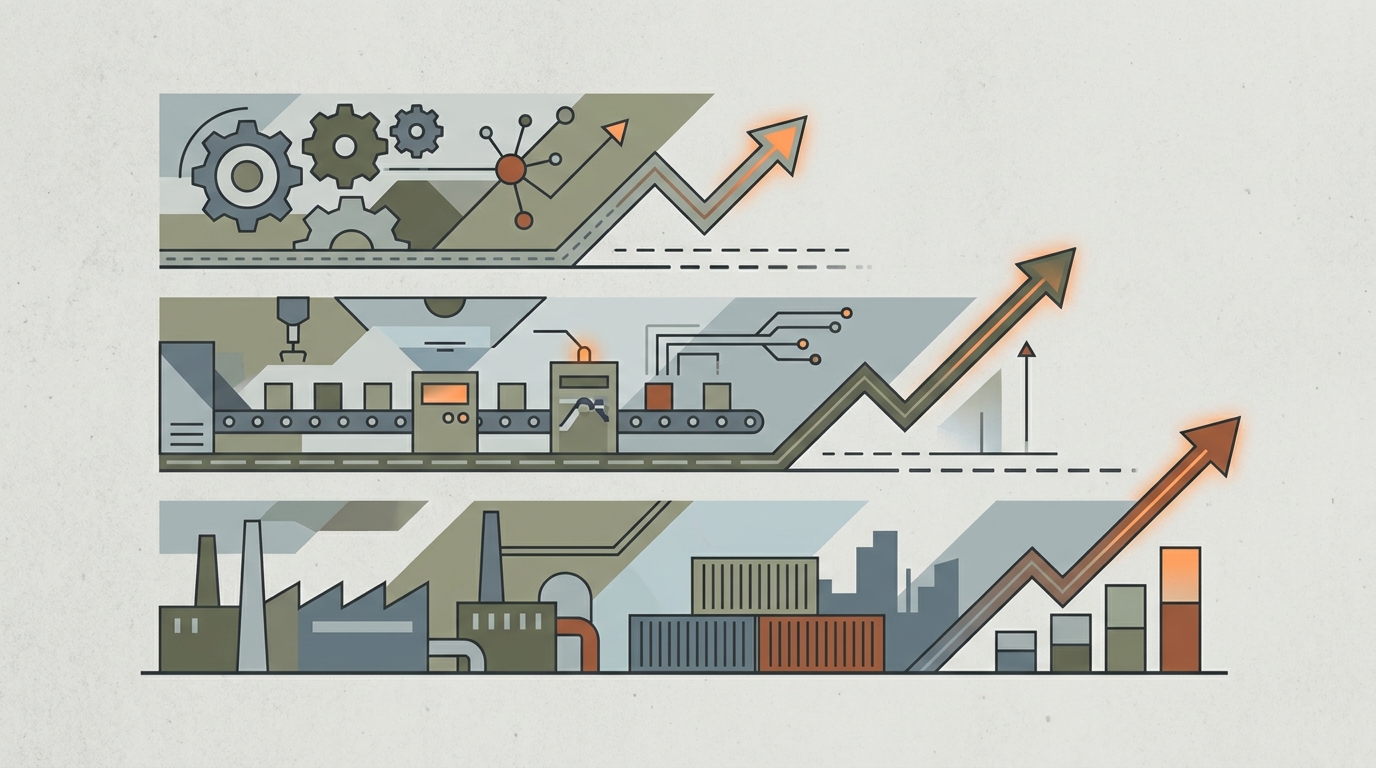
Short answer: the success of an AI rollout is not one number, it is measured on three levels at once. Adoption: are people actually using it in daily work. Process: is the metric the rollout was meant to improve actually moving, for example time per task, error count or cycle length. Business: does it flow through to cost or revenue. There is one necessary condition: a baseline measured before you start, because without a reference point you cannot prove any change. The most common mistake is measuring what is easy (the number of queries) instead of what matters (the process metric you set out to improve). Below we lay out the framework: three levels, leading and lagging indicators, and a review cadence with a clear adjustment criterion.
Why „does it work" is the wrong question
„Does the AI work" sounds reasonable, but it cannot be answered, because it does not say what was supposed to change. A model can answer accurately in a test and still change nothing in the work, if nobody uses it or if it improves a metric you did not care about. The better question is different: is the specific process the rollout was meant to improve measurably better today than before you started, and are people actually using it. Instead of a single „yes or no" verdict you need a few indicators tied to the goal you set at the start.
Three levels of measurement
Level 1: adoption
This is the most often skipped and usually the most important level. A tool nobody uses has zero return no matter how well it performs in a test. Measure whether the team uses the solution regularly and on real tasks, not just during a demo. Falling adoption after the first weeks is the earliest signal that something is off: either the tool does not fit the process, or it is slower than the old way, or people do not trust it. Adoption is a leading indicator, you see it before any process effects appear.
Level 2: process
Here you measure the metric the rollout was meant to improve, and only that. If the goal was faster service, what counts is the time from report to resolution. If a shorter quoting cycle, the time from inquiry to quote. If fewer errors in documentation, the number of corrections. The key is to pick that metric before you start, not to reach for whichever one happened to move afterwards. One well chosen process metric is worth more than five general ones.
Level 3: business
Only at the end do you look at whether the process improvement flows through to cost or revenue. This is the slowest level and the hardest to attribute, because many things affect a business result at once. So treat it as confirmation, not as the first signal. How to count this side honestly, without tacking on benefits you cannot defend, we broke down in ROI from AI in manufacturing.
Baseline: without it there is no measurement
The most expensive mistake is to launch a rollout and only then realise nobody measured how it was before. Without a baseline every post-rollout number hangs in the air, because there is nothing to compare it to. The baseline has to be taken before you start, on the same process and in the same way you will measure later. It does not have to be perfect, it just has to be consistent. The same condition returned in our piece on the pilot: a good pilot has a measured starting point, which we covered in from pilot to rollout.
Leading and lagging indicators
Leading indicators move early and tell you where you are heading: adoption, use on the target task, the first time savings. Lagging indicators move later and confirm the result: cost, rework, cycle length over months. The mistake is waiting only for the latter. If for the first weeks you look only at the business result, you lose the window in which the rollout could still be corrected. Watch the leading indicators from the first week, and the lagging ones over a quarter.
What not to measure: vanity metrics
Some numbers look good in a report and mean nothing. The number of queries to the system also rises when people ask several times because they did not find it the first time. „Engagement" and „number of documents generated" do not say whether the work is faster or better. Watch attribution too: do not credit AI with every improvement that simply coincided with the rollout. If a vanity metric rises while the target process stands still, you are measuring noise, not effect.
Review cadence and an adjustment criterion
Measurement with no review date blurs the same way a pilot with no decision date does. Put two checkpoints into the schedule, for example after a month and after a quarter, and at each ask the same questions: is adoption rising, is the process metric improving, what is missing. Set an adjustment criterion up front, that is, what you will do if adoption is low after a month. Sometimes the answer is more training, sometimes a change of scope, and sometimes an honest admission that the process did not benefit in its current shape. There also has to be one person accountable for these reviews, otherwise nobody runs them.
How this connects to ROI and the go/no-go decision
These three often get confused, yet they answer different questions. ROI you calculate before you start, to decide whether to go in at all, and it is a financial model built on assumptions. The go/no-go decision comes after a pilot and says whether to scale. The KPI framework in this post works after the rollout and answers whether it really worked in daily practice. The baseline and the process metric tie all three together, because without them you can neither calculate ROI, nor settle the pilot, nor measure success.
What this post does not cover
This is a framework for choosing and organising KPIs, not a ready set of metrics for your company, because that depends on the process you are improving. We do not give thresholds like „good adoption is X percent" or savings amounts, because every number depends on your starting point. We do not go into metric-collection tools or reporting setup. We also do not settle whether to build or buy the rollout, because that is a separate decision we broke down in the build vs buy comparison.
Related
- ROI from AI in manufacturing: how to calculate it and what to leave out
- From AI pilot to rollout: how to avoid pilot purgatory
- AI pilot in a factory in 8 weeks: what is real and what is marketing
- How to assess your manufacturing company's readiness for AI: 5 questions
- Five AI workflows already paying off in Polish manufacturing
FAQ
What is the single most important metric for an AI rollout?
There is not one, but if you have to name a starting point, it is adoption. A tool the team does not use has zero effect regardless of model quality. Adoption is also a leading indicator, so it warns you earliest.
When should you start measuring?
Before you start. A baseline taken on the target process before the rollout is a necessary condition, because without a reference point no later number means anything.
How is a KPI framework different from calculating ROI?
ROI you calculate before the rollout decision, on assumptions, to judge whether it pays off. The KPI framework works after the rollout and measures whether the process actually improved and whether people use it. It measures reality, not a forecast.
How long before you can tell whether a rollout succeeded?
Adoption and the first process effects show in weeks, the business effect over a quarter. That is why it helps to set two checkpoints, for example after a month and after a quarter.
Related notes

From AI Pilot to Rollout: How to Avoid Pilot Purgatory
Pilot purgatory is an AI pilot that neither wins nor fails, it just lingers in extensions. Why pilots get stuck and how to tell when yours is ready for a go/no-go call.
AI in Production Planning: Where It Helps, Where It Fails
AI in production planning: where it genuinely helps and where it only creates an illusion of control. Which scheduling and APS uses hold up, and which are vendor promises.

Build vs Buy AI in Manufacturing: Own Model or Off-the-Shelf
Build your own AI model or buy a ready one. An honest decision framework for manufacturers: maintenance cost, people, time to value, and risk. When buying wins, and when building makes sense.