
AI ROI in manufacturing: how to build the business case
How do you build an honest business case for AI in manufacturing? Which benefits to count, which to leave out, what hidden costs to include, and a ready ROI worksheet to fill in with your own numbers.
In this note
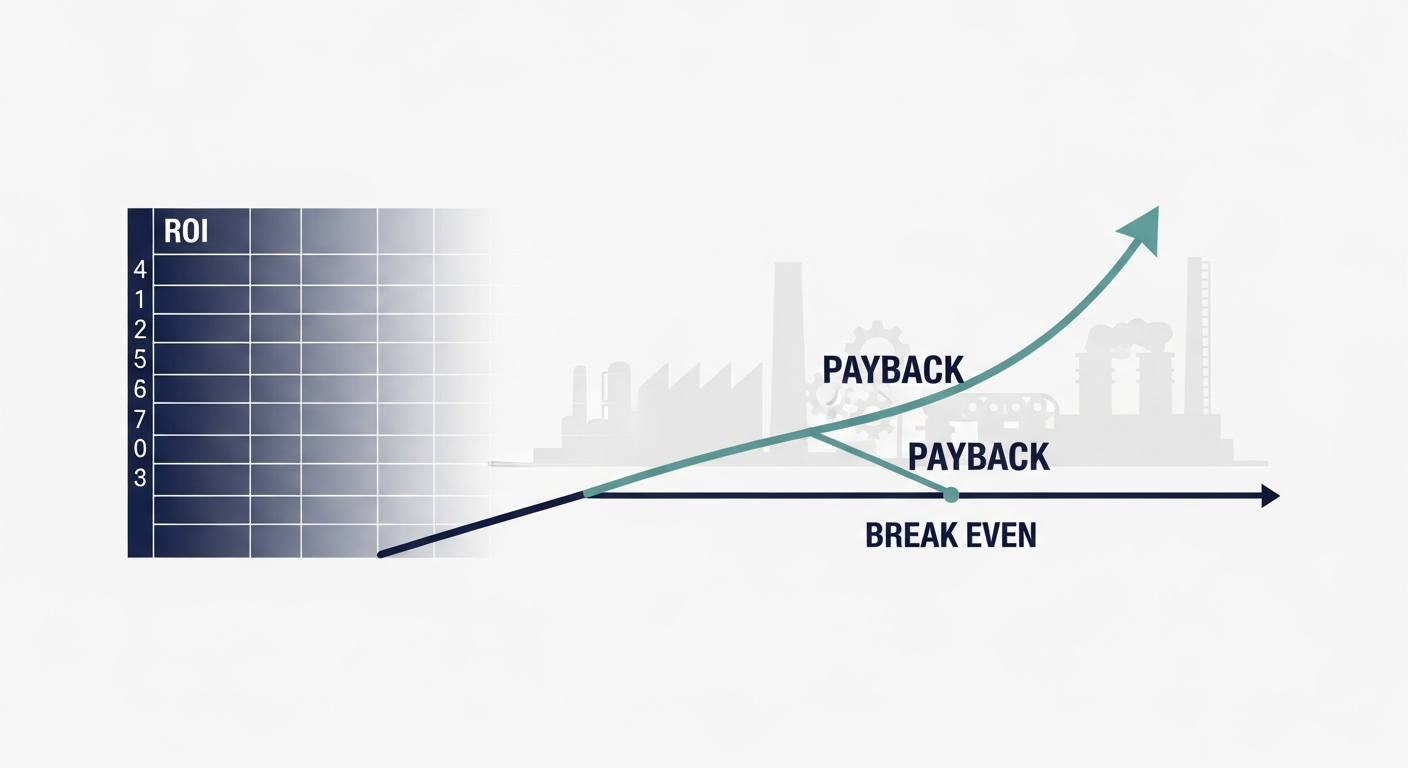
Short answer: ROI from AI in manufacturing works like any other business case, with one difference. Benefits have to be tied to a specific process, not to a vague "productivity boost". Take two or three workflows for which you already have today's time data (a baseline), multiply the time saved by the hourly rate, add the cost of rollout and upkeep, and check the payback. Under honest, conservative assumptions the first workflow usually pays back in 9 to 18 months. If it comes out under 6 months, the assumptions are probably too optimistic. Below we break down what belongs in the benefit column, how to catch hidden costs, and give a worksheet to fill in with your own numbers.
Before a company signs with an AI vendor, someone has to stand in front of finance and say when it will pay for itself. That is usually where two mistakes appear: either the business case is too optimistic and a year later nobody can explain why the numbers "did not quite work out", or it is so cautious that the project never gets a green light.
This post is about how to count honestly.
What goes into the benefit column (and what does not)
Start with the upside. In AI for manufacturing, three categories of benefit genuinely pay for themselves:
Specialist time saved. If a service assistant cuts the time needed to draft resolution steps, and technicians handle a high volume of tickets each month, the saved hours add up to a meaningful line item on a single workflow. This one you can count hard: ticket count times time saved times the hourly rate.
Shorter quoting cycle. A technical office that today needs several days to draft a quote for drawing-based inquiries gets down to part of a day with AI in the loop. With a steady stream of inquiries and the company's usual win rate, that directly means more closed deals in the same team hours.
Fewer errors and less rework. Work instructions generated from source documentation deviate from the standard less than those written from memory. This is harder to quantify than hours, but if the company tracks rework costs, it is worth a look.
What does not go into the business case:
- A "productivity boost of X%" with no specific process behind it.
- "Savings from not hiring", unless there is an open role you genuinely do not want to fill.
- Benefits from workflows that are not yet in the rollout scope.
- "Possible sales growth", unless it flows directly through a specific process (e.g. the quoting cycle).
Experience shows that a business case with three concrete, measurable line items is harder to argue with than one with eight "estimated" ones.
How to count the costs (without skipping the hidden ones)
AI rollout costs tend to grow beyond the vendor invoice. Typical hidden items:
Internal time during onboarding. Someone has to gather the source documentation, check its quality, and describe the processes. In a solid rollout that is several dozen hours of the process owner's time in the first weeks. At a specialist rate, it is worth pricing in.
Integrations. If the AI has to read from an ERP or ticketing system, someone has to connect it. A simple connector: a few days. A custom one: a few weeks and a dedicated developer.
Knowledge model upkeep. Documentation ages. Someone has to keep the knowledge base current. This is not a one-off cost, it is operational.
Hardware or infrastructure (if on-prem). A GPU appliance, a server, system licenses. It amortizes differently than a SaaS subscription, so count the TCO, not just year 1.
For a mid-size manufacturer, the cost to roll out the first workflow with integration and the annual upkeep are two separate line items to price with the vendor, not to assume up front. More complex integrations push both up, and on-prem hardware comes on top.
A simple business case template
The structure that works in front of an investment committee:
| Line item | How to calculate |
|---|---|
| Time saved per month | ticket count × time delta × rate |
| Revenue from faster quoting | quote count × time cut × win rate × ACV |
| Rework reduction | defect % × rework cost per year |
| Total benefits per year | sum of the above |
| Rollout cost (one-off) | invoice + internal time + integration |
| Upkeep cost (annual) | subscription or hardware amortization + ops time |
| ROI (year 1) | (benefits - costs) / costs |
| Payback period | total cost / benefits per month |
A worksheet to fill in for your company
Instead of ready-made amounts that are easy to read as a benchmark, a table to fill in with your own data. Put your baseline in the last column, the middle column tells you where each number comes from.
| Line item | Where the number comes from | Your value |
|---|---|---|
| Time saved per month | ticket count × time delta × rate | ____ |
| Revenue from faster quoting | quote count × time cut × win rate × ACV | ____ |
| Rework reduction | defect % × rework cost per year | ____ |
| Adjustment for real effectiveness (× 0.75) | multiply the benefit total, do not assume 100% | ____ |
| Rollout cost (one-off) | vendor quote + integration + internal time | ____ |
| Upkeep cost (annual) | subscription or amortization + ops time | ____ |
| ROI year 1 | (benefits - costs) / costs | ____ |
| Payback | total cost / benefit per month | ____ |
Once you fill in the framework, sanity-check the result. The ranges below are not a promise of results, just a reference point from typical first-workflow rollouts:
| Indicator | What usually comes out | What should raise a flag |
|---|---|---|
| Payback of the first workflow | 9 to 18 months | under 6 months (too optimistic) or over 36 months (wrong first process) |
| ROI year 1 | often negative, because rollout is a one-off cost | positive already in year 1: check whether costs were skipped |
| Number of benefit line items | 2 to 3 hard, measurable | 6 or more "estimated" ones: the business case is drifting |
| Effectiveness adjustment | a 0.7 to 0.8 factor | no adjustment (100%): overestimation |
The key intuition: year 1 of the first workflow usually comes out negative, because the rollout cost is one-off while benefits accrue over time. A payback under 6 months should be a flag that either the rollout cost was set too low or the benefits too high.
When not to count, but to pilot instead
Sometimes the business case is hard to build up front, because there is no historical process-time data or the scope is unclear. In that case it is better to propose a limited pilot with clear success metrics than to spend 3 weeks on a financial model built on assumptions.
A good pilot has:
- one specific process (e.g. an assistant for service tickets),
- a baseline before rollout (how long it takes today),
- a measurable goal (e.g. a defined cut in time per ticket),
- a time horizon (6 to 8 weeks is the minimum).
After the pilot you have data, not assumptions. And it is far easier to defend the decision to scale.
What this post does not cover
This is a framework for calculating a business case, not a finished financial model for your company. We do not get into accounting depreciation methods or the tax treatment of AI spend, because that depends on jurisdiction and company policy. We do not compare specific vendors or price lists here, and we do not settle the on-prem versus cloud choice, because that is a separate cost topic. We also do not give ready amounts in the ROI framework, because every result depends on your baseline, the formulas only show how to calculate.
Related notes
- Five AI workflows already paying for themselves in Polish manufacturing, an overview of the five processes whose ROI we calculate in this post.
- AI service assistant: why a mid-size manufacturer is a good candidate, the workflow the technician time-saving example comes from.
- AI for generating work instructions: how it works and what it costs, where the error and rework reduction in the calculation comes from.
- How to assess a manufacturer's readiness for AI: 5 questions, before you calculate ROI, check whether there is anything to calculate.
Related notes
How to measure whether an AI rollout succeeded: a KPI framework
The success of an AI rollout is not one number. A KPI framework on three levels (adoption, process, business), with a baseline before you start and an adjustment criterion. How to measure whether it really worked.

From AI Pilot to Rollout: How to Avoid Pilot Purgatory
Pilot purgatory is an AI pilot that neither wins nor fails, it just lingers in extensions. Why pilots get stuck and how to tell when yours is ready for a go/no-go call.
AI in Production Planning: Where It Helps, Where It Fails
AI in production planning: where it genuinely helps and where it only creates an illusion of control. Which scheduling and APS uses hold up, and which are vendor promises.