
AI Pilot in a Factory in 8 Weeks: What Is Real and What Is Marketing
A meaningful AI pilot in manufacturing fits into 8 weeks, but only as an answer to one narrow question. What you can validate, and what is just a sales line.
In this note
AI Pilot in a Factory in 8 Weeks: What Is Real and What Is Marketing
Reading time: approx. 7 min
Short answer first
Yes, a meaningful AI pilot in manufacturing can fit into eight weeks, but only when it answers one narrow question: does this specific workflow, run on your data, produce a result good enough to justify going further. Eight weeks is enough for a proof of concept on a real slice of data, with the people who will actually use it. It is not enough for a full rollout, integration with every system, or „testing AI in the company" in the abstract. When someone promises the latter in the same window, they are selling you a timeline, not an outcome. Below we break down what genuinely fits into those eight weeks, what is a marketing line, and how to tell when a pilot is ready for a go/no-go decision.
Why the scope of the question decides everything
The word „pilot" means different things to different people. For a vendor it often means „a demo on our showcase data". For you it should mean „a test on our slice, our documents, with our people in the loop". Only the second definition settles anything.
Eight weeks is realistic when the pilot question is narrow. „Does an assistant built on our service documentation answer typical technician questions more accurately than searching through PDFs" is a good pilot question. „Will AI improve our production" is not a question, it is a slogan. The narrower the question, the more credible the result inside a fixed window.
A good pilot has one measurable hypothesis, one slice of data, and a success criterion defined up front. Without that last piece, after eight weeks you are left with an impression instead of a decision.
A realistic breakdown of eight weeks
This is not a vendor schedule. It is the split that protects you from an empty pilot.
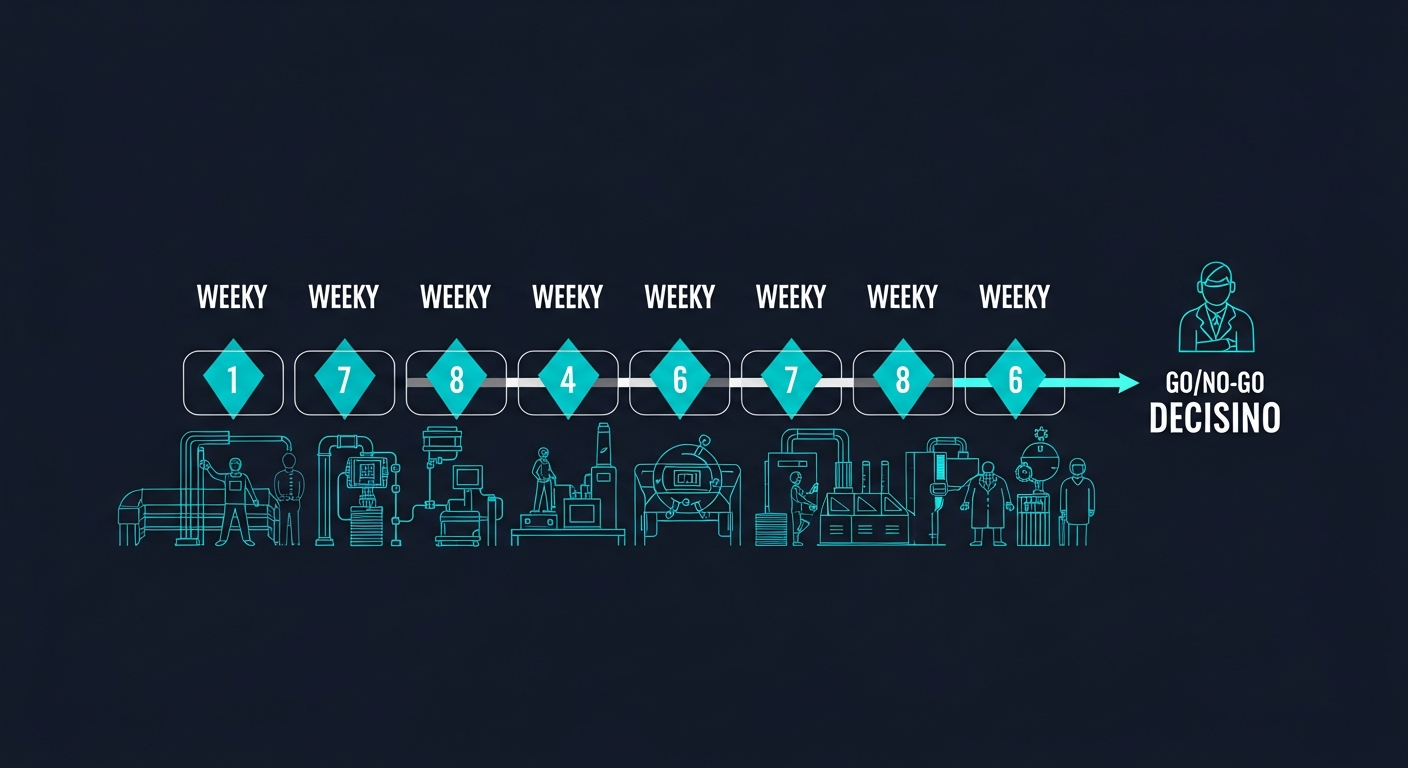
Weeks 1 to 2: narrow the scope and gather data. Pick one workflow, collect a representative slice of documents or tickets, and define the success criterion in numbers or in clear terms. This stage is the most underrated, and it determines the quality of everything that follows.
Weeks 3 to 5: setup and first iterations. Run the solution on the slice, get first answers, correct course. This is usually where it turns out the data is messier than anyone assumed. That is normal, and it is also a pilot result.
Weeks 6 to 7: test with real users. The people meant to benefit work with the solution for real and note where it helps and where it misleads. Without this step you have a technical assessment, not an operational one.
Week 8: collect results and decide. Compare against the week 1 criterion, name honestly what worked and what did not, and make a go/no-go recommendation with reasoning.
What is marketing, not a pilot
A few promises that are red flags inside an eight week window:
„We will roll out AI across the whole company in eight weeks." Rollout and pilot are different things. A pilot answers a question, a rollout delivers the answer in production, with integrations, training, and maintenance. Blurring the two is the most common sales move.
„We do not need your data, we will show it on ours." A demo on someone else's data tells you nothing about your result. If the pilot never touches your documentation, it is not a pilot, it is a presentation.
„We guarantee a specific percentage gain." Before a pilot, nobody honestly knows the number, because it depends on the quality of your data and the specific workflow. Promising a hard result before the test is selling an impression.
„The pilot is free." A pilot can be priced low, but „free" usually means its purpose is a signature, not a result. A pilot that is not allowed to end in „no-go" is not a test.
How to tell a pilot is ready for a decision
A pilot is ready for go/no-go when you have four things: a result measured against the criterion set at the start, feedback from real users, a clear picture of the state of your data, and a first outline of what a full rollout would mean. If any of these is missing after eight weeks, the pilot has not matured, no matter how good the demo looked.
A „no-go" after a well run pilot is also valuable. It means you paid a small price for the information instead of overpaying for it in a full rollout.
What this post does not cover
We do not get into the criteria for moving from pilot to scale, or how to avoid getting stuck between pilot and production, that is a separate topic. We also leave out regulatory questions and data security during a pilot, since they follow their own logic. The focus here is strictly on what fits into an eight week window.
Related
- How to assess a manufacturing company's readiness for AI: 5 questions
- ROI from AI in manufacturing: how to calculate it and what to leave out of the business case
- AI for service knowledge management: how to feed the system and where the limits are
- AI service assistant and maintenance: what works, what does not
Related notes

How to measure whether an AI rollout succeeded: a KPI framework
The success of an AI rollout is not one number. A KPI framework on three levels (adoption, process, business), with a baseline before you start and an adjustment criterion. How to measure whether it really worked.

From AI Pilot to Rollout: How to Avoid Pilot Purgatory
Pilot purgatory is an AI pilot that neither wins nor fails, it just lingers in extensions. Why pilots get stuck and how to tell when yours is ready for a go/no-go call.
AI in Production Planning: Where It Helps, Where It Fails
AI in production planning: where it genuinely helps and where it only creates an illusion of control. Which scheduling and APS uses hold up, and which are vendor promises.