
AI for Service Knowledge Management: Feeding the System and Its Limits
A service assistant is only as good as the knowledge you feed it. This post is about that knowledge: where it lives, how it reaches the model, why retrieval sometimes fails, and how to keep quality from rotting as ticket volume grows.
In this note
AI for Service Knowledge Management: Feeding the System and Its Limits
Reading time: approx. 8 minutes
Most companies asking about an AI service assistant are really asking one thing: "will it pay off?" That's a fair question, and we answered it separately. But once the decision is made, a harder and ultimately more decisive question follows: what will this assistant be fed, and who will make sure the knowledge inside it doesn't rot.
Because a service assistant is, at its core, an access layer over knowledge the company already has. The model itself knows nothing about your machines. All of the value comes from how well you supply it with your documentation, your failure history, and the things currently sitting in your technicians' heads. This post is about exactly that: managing service knowledge, not whether it's worth doing.
What "service knowledge" actually means
The first mistake is assuming service knowledge equals machine manuals. Manuals are just one layer, usually the least useful in practice, because they describe how a machine is supposed to work, not how it actually fails.
In reality, service knowledge is made up of four distinct types of material, each with a different quality level and a different processing difficulty:
- Manufacturer documentation (technical sheets, manuals, diagrams). Structured, but generic and often disconnected from how the machine behaves on your floor.
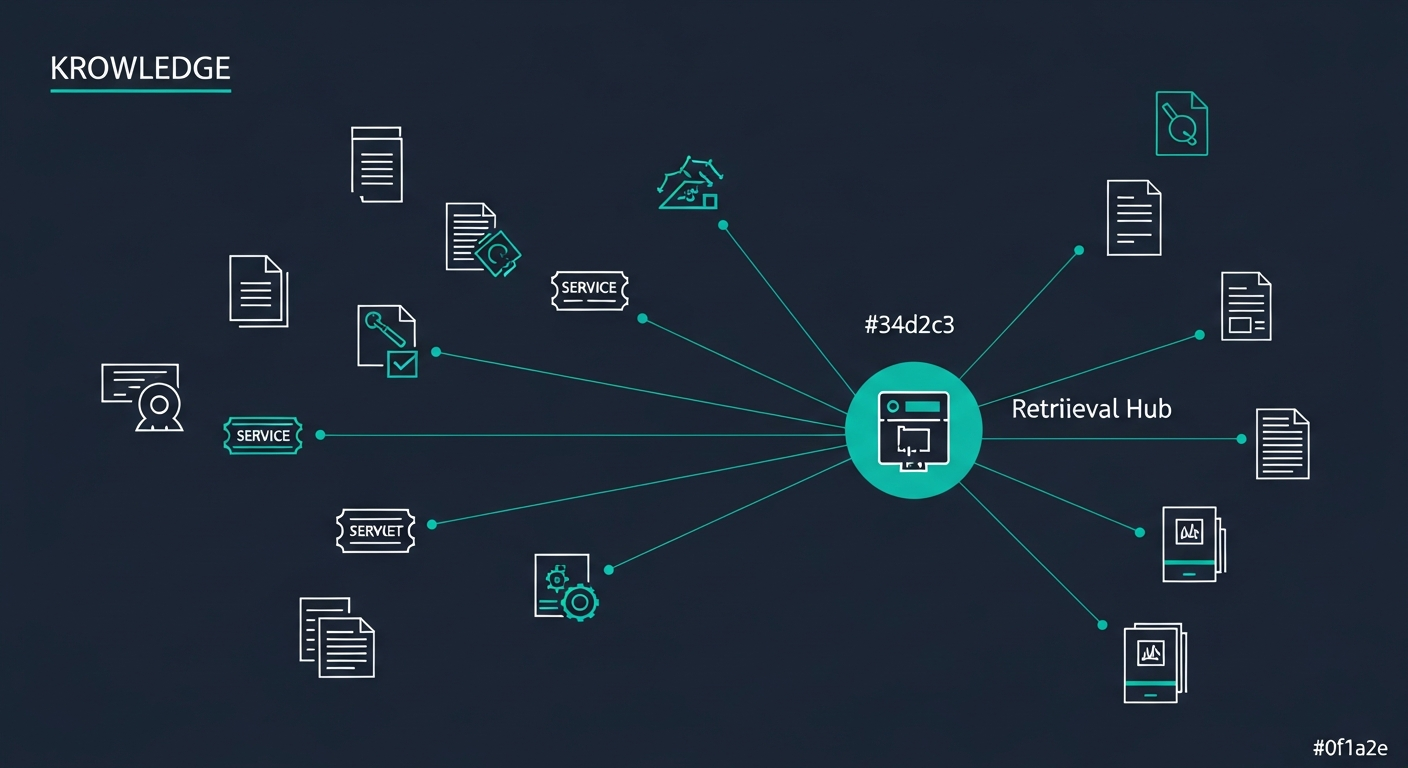
- Ticket history (from your CMMS, helpdesk, or spreadsheets). The most valuable layer, because it captures real faults and real fixes, yet usually written in terse, inconsistent shorthand. We show a concrete workflow that uses this history on a new ticket in RAG on service documentation for machine service.
- Tacit knowledge (what a technician knows but never wrote down). The hardest to extract and, at the same time, the knowledge whose loss hurts most when someone leaves.
- Scattered communication (emails, notes, phone photos, chat messages). Chaotic, but often the only record of how an unusual case was actually solved.
Service knowledge management starts with an honest inventory of these four layers. Skip that step and it's easy to deploy a tool that quotes the manufacturer's manual beautifully and knows nothing about the real failures of the last five years.
How that knowledge reaches the model: retrieval, not "training"
Worth clearing up one misconception here. In most sensible deployments, a service assistant is not "trained" on your data in the sense of retraining the model. It works through retrieval: when a ticket comes in, the system searches your materials for the fragments most relevant to the query, and only then assembles an answer based on them. This approach is known as RAG (retrieval-augmented generation).
This has two important practical consequences.
First, answer quality depends directly on whether the right fragment can be found at all. If a fix exists but is described in three words with no context, retrieval won't surface it, no matter how good the model is. That's not a problem of model intelligence; it's a problem of how the knowledge is recorded and described.
Second, adding new knowledge is cheap and fast. A new machine type, a new manual, a new batch of tickets, you simply add them to the base rather than retraining the model from scratch. That's good news for managing knowledge over time, because the system grows alongside your documentation instead of freezing the state it had on deployment day.
Why the model sometimes answers confidently and wrong
The most dangerous trap with a service assistant isn't a missing answer, it's a confident answer that's wrong. It's worth understanding where this comes from, because it shapes how you manage knowledge.
A text-generating model always tries to produce a coherent, plausible-sounding answer. If your base has no good match, a well-designed system will say plainly "I found no basis in the documentation." A poorly configured one, or one fed weak knowledge, will instead stitch together an answer from loosely related fragments that happen to sound credible.
Hence two rules that belong to knowledge management, not to the IT department:
- Enforce source citation. Every suggestion should point to which document or which ticket it came from. The technician can then see whether an answer has real grounding or merely sounds good.
- Treat "I don't know" as a correct answer. A system that sometimes admits it has no basis is far safer than one that always invents something. This is partly configuration, but also culture: the team needs to know that a blank field is a signal to fill a gap, not a flaw in the tool.
Knowledge hygiene: the part nobody wants to think about
Deployment is only the beginning. Service knowledge ages and clutters, and a system fed garbage returns garbage, only faster and with more confidence.
A few mechanisms worth setting up from the start:
The first is closing tickets with a real description of the fix, not "fixed, ok." It's the cheapest investment in quality, because every properly described ticket feeds the system for all the ones that follow. A well-designed assistant can even walk the technician through that description, turning an obligation into a guided exchange.
The second is flagging outdated knowledge. A machine gets upgraded, a procedure changes, a part is discontinued, and the old manual still sits in the base. Without a process for retiring stale content, the system will increasingly suggest things that used to be true.
The third is reviewing the most frequent questions with no good answer. That's a ready-made map of knowledge gaps: if technicians regularly ask about something the system can't back with a source, you know exactly what to fill first. This report is often more valuable than the assistant itself, because it shows where your organization genuinely doesn't know.
Who owns the knowledge
A tool without an owner dies, no matter how good it is technically. Service knowledge management needs a clearly named person or small team responsible for base quality: keeping descriptions clean, retiring stale content, reviewing gaps.
This doesn't have to be a full-time role. In a mid-sized company, an experienced technician or a maintenance manager with dedicated time and a clear mandate is usually enough. What matters is that the role exists formally. Knowledge that nobody tends degrades exactly the way a machine park does without inspections.
What this post doesn't cover
I've deliberately left a few threads aside. I don't get into "does a service assistant pay off, and for whom," because that's a separate topic, covered in the note on the service assistant for a mid-sized company. I also don't go into the technical architecture of retrieval, local models, or infrastructure sizing, that's the territory of more technical write-ups. The focus here was one thing: the knowledge itself, its quality and its upkeep, because those decide whether the assistant becomes real support or a nicely packaged guess generator.
Related notes
Related notes
AI service assistant and maintenance: what works, what does not
An AI service assistant is one of the few uses of AI in maintenance that pays off at a mid-sized factory without a three-year wait. Three uses that genuinely work, two that usually disappoint, who it pays off for, and where to start.
AI in a mid-sized factory in 2026: what stuck, what fell away
A review of the first half of 2026 in mid-sized manufacturers: which AI use cases made it into daily work, which stayed on the slide deck and what made the difference.
AI for generating work instructions: how it works and what it costs
How AI-driven generation of work instructions actually works in mid-size manufacturing. Pipeline architecture, cost categories (pilot PLN 30 to 70k, full deployment 4 to 6 months), when ROI lands under 18 months, when to skip.