Drawing-to-offer AI: from a technical drawing to a price quote
Quoting from a technical drawing is a bottleneck that costs you orders. How AI cuts the cycle from days to hours, where the limits are, and what you need to make it work.
In this note
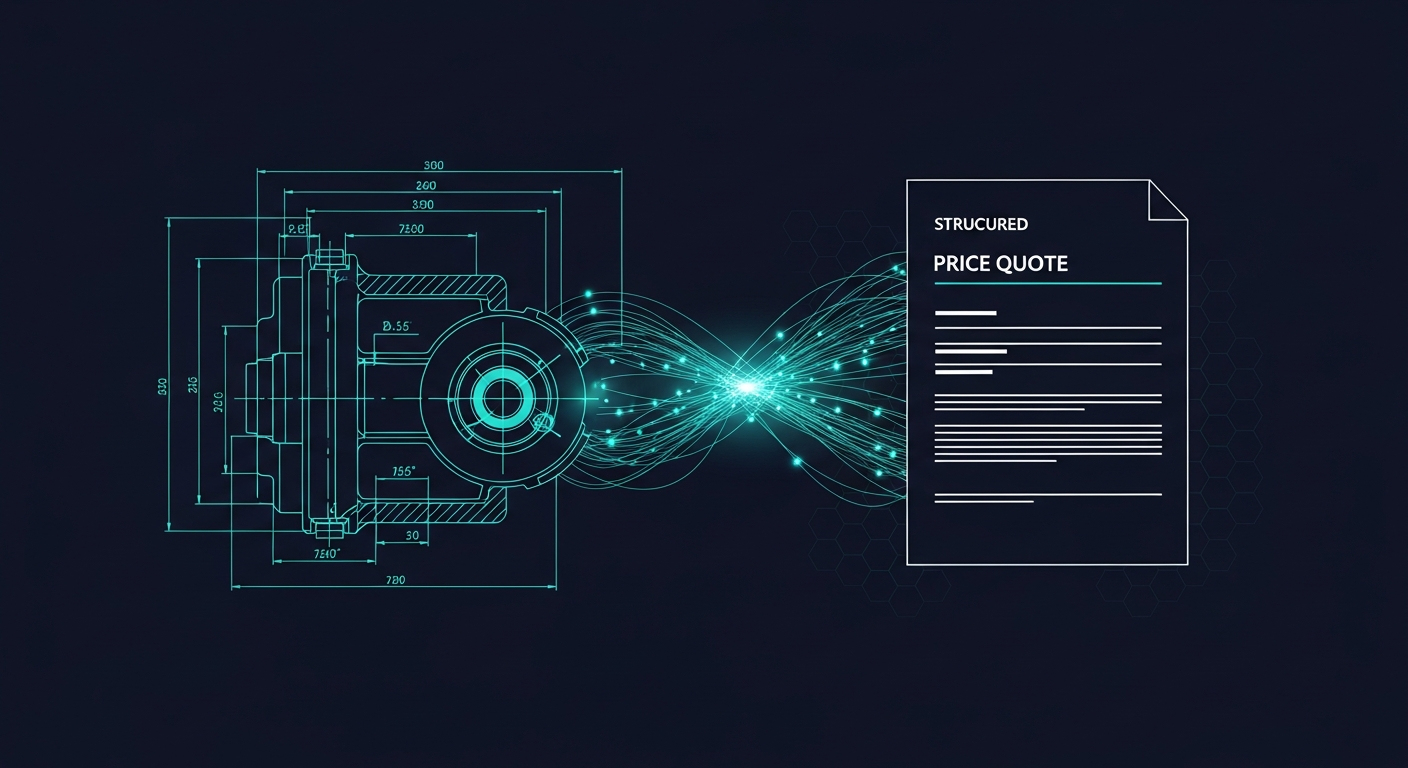
A request for quote lands as a PDF with a technical drawing, or a DWG file. Sales hands it to the engineering office. There, someone opens the drawing, reads off the dimensions, material, tolerances and number of operations, picks the technology, estimates machine and labour time, checks material prices — and two or three days later comes back with a quote. Sometimes five days. By then the customer already has an offer from a competitor.
This is exactly the kind of narrow, costly, repeatable process worth starting an AI conversation around. Drawing-to-offer — from a drawing to a quote — is one of the few workflows where the return shows up fast, because the bottleneck is the time of an expensive specialist, not the machine itself. Below I break down what AI actually does here, where its competence ends, and what you need in place before you start.
Contents
- What the quoting bottleneck really is
- What AI actually automates
- What AI won't do for you
- What you need for it to work
- What a realistic return looks like
- Where to start
1. What the quoting bottleneck really is
In a mid-sized manufacturer — machining, steel structures, injection moulding, sheet metal — quoting is often the slowest link between an enquiry and an order. Not because people work slowly. Because every quote means reading a drawing, understanding the designer's intent, and translating it into operations, material and time.
The problem has two layers. The first is volume: there are many enquiries, and you have to quote each one, including those that will never turn into an order. The second is concentrated knowledge: only two or three people in the company can quote a drawing sensibly, and those same people are needed for ten other things. The result is a queue of enquiries waiting, while your best engineers spend the day costing offers, half of which will fall through.
2. What AI actually automates
Drawing-to-offer doesn't replace the engineer. It takes the first, most mechanical 60–70% of the work off their desk and hands back a result to approve. In practice it looks like this.
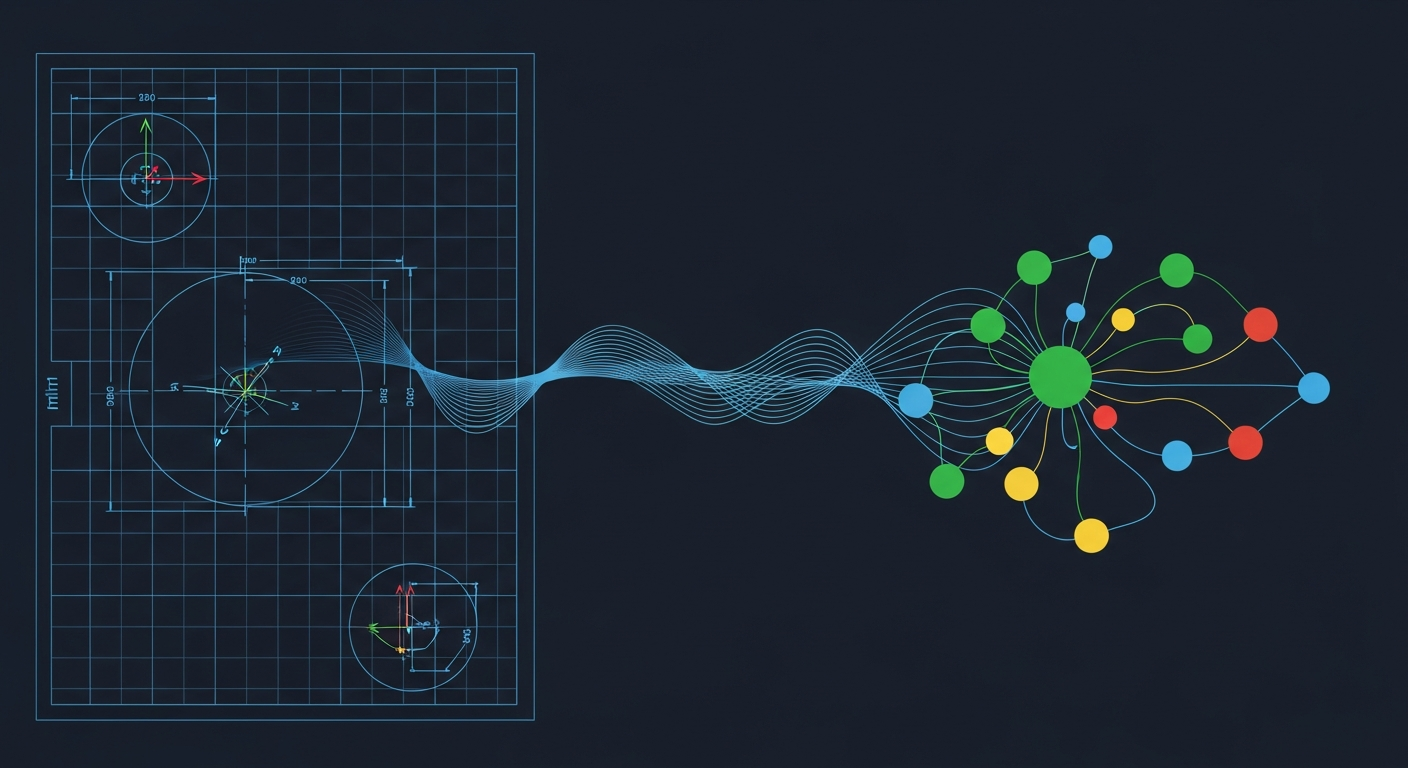
Reading the drawing. The model extracts the key data from a technical drawing or 3D model: overall dimensions, material, tolerances, weld symbols, threads, the number and type of operations. The things a person reads off by eye today and types into a sheet.
Mapping to technology. Based on the part's features, the system proposes a routing: which operations, in what order, on which machines. It draws on your history — how similar parts were quoted and produced before.
A first calculation. An estimate of machine and labour time, material costed at current prices, overheads added per your own rules. The output is a draft quote, not a final price.
A first draft of the document. A ready outline of the offer in your format, which the salesperson or engineer corrects and sends — instead of building it from scratch.
The key word is draft. AI delivers a starting point in an hour instead of three days; the human verifies it and takes responsibility for the number that goes to the customer.
3. What AI won't do for you
Here's a line worth drawing honestly, because it's what separates a working project from a burned pilot.
The model won't catch an unstated design intent that isn't on the drawing — "the customer will surely want heat treatment here, even though they didn't write it." It won't quote an unusual part with no analogue in your history better than an experienced engineer would. It won't make a commercial call: whether to drop the price to win a new customer, or to deliberately pass on a risky order. And it won't take responsibility for an error — that stays with the person who signs off the offer.
So drawing-to-offer is assistance, not autopilot. It works best on repeatable, moderately complex parts where history gives the model something to stand on. The more unique the part, the bigger the human's role — and that's the right division of labour, not a flaw in the system.
4. What you need for it to work
The quality of drawing-to-offer depends on your data, not on the model. Before you calculate ROI, check three things.
First, a quoting history in a form that can be read — not loose PDFs scattered across inboxes, but linked records: the drawing, the technology used, the quoted and actual time, the final price. That's the fuel the system learns your reality from.
Second, drawings of reasonable quality. Clean vector files or 3D models work far better than scanned faxes from a decade ago. If half the archive is photos of drawings on a desk, that's the first piece of homework.
Third, calculation rules written down, not in someone's head. Rates, overheads, material coefficients, the logic for add-ons. If that's the knowledge of Marek from engineering, it has to be extracted first — which is valuable in its own right, independent of AI.
If you recognise the "only one person here knows that" picture, this is a good moment to run our short AI readiness self-check — five questions that tell you whether you're ready for a pilot, or for some tidying up first.
5. What a realistic return looks like
The return on drawing-to-offer comes from two sources, and it's worth keeping them apart.
The first is engineer time. If preparing a quote drops from three days to a few hours, the same team handles several times more enquiries without growing the department — or wins back time for work that genuinely needs an engineer. The second, often more important, is orders won. In tenders and enquiries where speed counts, an offer sent the same day beats one sent on the fifth day, even at a similar price.
Don't put savings you can't measure into the business case, and don't assume AI will replace people — that's the classic mistake that wrecks a project's credibility. How to calculate this return honestly, and what to leave out of it, we covered separately in our piece on ROI from AI in manufacturing. Drawing-to-offer is also one of the five workflows that actually pay for themselves in Polish manufacturing — there we show it in a wider context.
6. Where to start
Don't start with the whole archive and every part type at once. Pick one repeatable product family — one that generates plenty of enquiries and has a rich history. Set a narrow pilot on it with a clear metric: the reduction in quote-preparation time and the share of quotes the engineer accepts without major corrections. Give yourself a few weeks and a hard go/no-go at the end.
If a pilot on one part family shows the draft quote is useful in most cases, you have a foundation to expand. If not — you found that out cheaply, on a narrow slice, before investing in the whole process.
Not sure whether your company is even ready to start? Run our AI readiness self-check: five questions — ten minutes that separate a real pilot from the tidying-up you need to do first.
Related
Related notes
How much data does an AI assistant in the technical office need: real sizing
What decides the quality of an AI assistant in the technical office is not gigabytes but the consistency of your sources. Real sizing: chunks, volume thresholds and why the naive setup fails.
AI in technical documentation quality control: what it catches, what it misses
AI in technical documentation quality control catches formal inconsistencies: drawing versus spec, gaps, wrong versions. We show what it catches, what it misses, and where a person stays in the loop.
AI in the engineering design office: what it really automates and what it just promises
A demo looks impressive, the daily reality of a design office is different. We break down which tasks AI really takes off the engineer and which stay slideware.